Thank you! Your submission has been received!
Oops! Something went wrong while submitting the form.
By signing up for your free account, you agree to receive e-mails from Triggre.
By signing up for your free account, you agree to receive e-mails from Triggre.

Generative AI and large language models (LLMs) are rapidly becoming part of business automation strategies. They can summarize documents, classify information, and support decision-making. For operations managers, business analysts, and innovation managers, the potential is clear.
However, generative AI also introduces risks when used incorrectly in business processes. The core issue is simple: LLMs are probabilistic systems, while business processes are typically deterministic. If that difference is ignored, automation can become unreliable.
Below are the most common pitfalls and how to avoid them.
Business processes are designed to produce predictable outcomes. A process should reliably lead to a defined decision, e.g. approve / reject / send for review.
This is deterministic logic: the same input should produce the same result.
LLMs work differently. They generate outputs by predicting the most likely sequence of words. Because of this probabilistic nature, the same prompt can produce slightly different answers.
.gif)
When LLMs are used directly to make process decisions, this variability can create problems. For example, asking a model to “evaluate this customer complaint” may result in responses that vary from one run to the next, making automation difficult.
One of the most discussed risks of generative AI is hallucination: the model produces information that appears plausible but is incorrect or lacks credible sources.
It is important to understand that hallucinations are not simply errors, but natural consequence of how LLMs work. The model predicts likely text based on patterns in training data. It does not verify facts or reason about correctness in the way a rule-based system does.
In a business process, hallucinations can lead to problems such as:
This does not mean LLMs should not be used. It means their probabilistic nature must be managed carefully.
Another common pitfall is using AI as the default solution.
Generative AI is powerful, but it is not always the best tool for automation. In many situations, traditional workflow automation or rule-based logic is more reliable, easier to maintain, and easier to audit.
For example:
These tasks are deterministic by nature and are better handled with standard automation logic.
AI should be used where interpretation or ambiguity exists, not where clear rules already solve the problem.
Even when AI is appropriate, results depend heavily on prompt design.
A common mistake is asking LLMs to generate large, open-ended outputs. The more freedom the model has, the more variation and uncertainty you introduce into the process.
For business automation, the goal is the opposite. You want controlled outputs that can be used inside workflows.
A useful principle is: Large descriptive input → small, structured output.
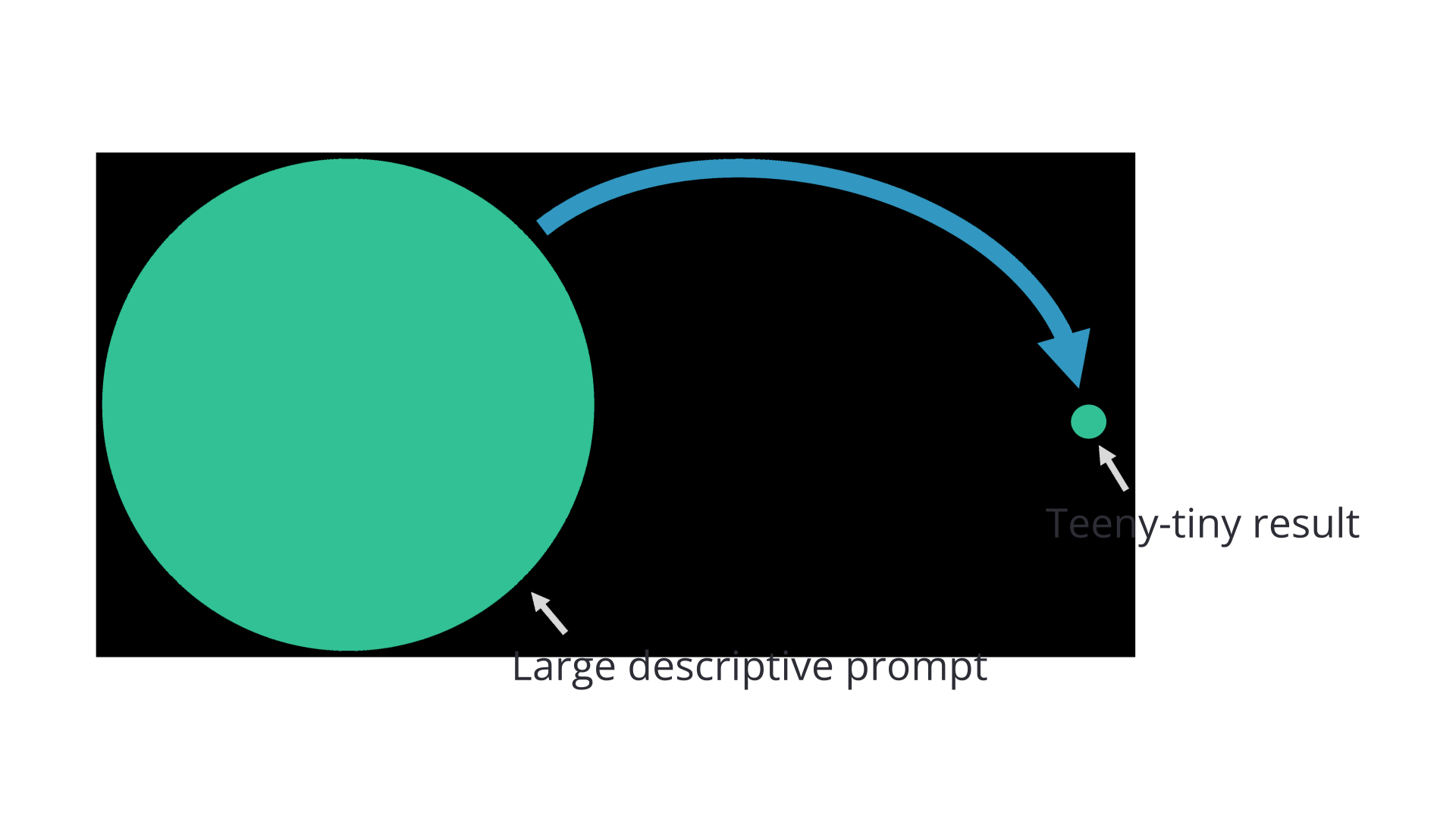
This means you provide the model with enough context to understand the task, but request a narrow, clearly defined result.
Another risk arises when AI outputs directly trigger automated actions without validation. For example, if an AI model classifies a request as “refund approved,” and that result automatically triggers payment, errors become costly.
Instead, AI should often be used as a supporting component, not the final authority.
Common guardrails include:
This hybrid approach combines the strengths of AI and deterministic automation.
LLMs can generate fluent and convincing responses, which can create the impression that they truly understand business context.
In reality, the model is predicting text patterns. It does not have awareness of company policies, compliance requirements, or operational constraints unless they are explicitly provided.
This means organizations must carefully design prompts, context inputs, and validation steps.
Businesses can reduce risk by following a few practical guidelines:
By following the above, organizations can use generative AI in a way that strengthens, rather than destabilizes, their business processes.