Thank you! Your submission has been received!
Oops! Something went wrong while submitting the form.
By signing up for your free account, you agree to receive e-mails from Triggre.
By signing up for your free account, you agree to receive e-mails from Triggre.
AI tools may help individuals work faster, but they rarely improve the business processes you’re responsible for.
Triggre’s blueprints embed AI into your daily work, combining automation and human expertise to deliver measurable improvements in time, cost, and quality.
AI is often introduced in organizations as a quick productivity boost, and is widely used for individual tasks such as writing emails, summarizing meetings, or generating content. However, these AI initiatives are hard to turn into real operational improvement. For people responsible for processes and innovation, the problems show up quickly.

AI adoption varies per person instead of following a defined process. That makes ownership unclear and execution inconsistent.

AI may “feel” faster, but it rarely connects to a specific process or KPI. Its real value remains unclear, making it hard to justify scaling or investment.

AI doesn’t change how work gets done. Bottlenecks remain, handovers stay manual, and quality is still inconsistent.
AI creates real value when it supports how work gets done — not as a separate tool, but as part of the process itself. When AI is embedded into repeatable processes, three things change:

AI is applied in a defined way, every time. This creates a shared way of working and reduces variation.

Because AI is tied to a specific process, its performance can be measured and improved over time.

Well-designed processes can be reused and rolled out across teams or departments without adding complexity.

At Triggre, we see the same pattern across industries and departments. AI has clear potential, but teams struggle to embed it in their processes and turn it into something operational.
That’s why we created the AI blueprints.
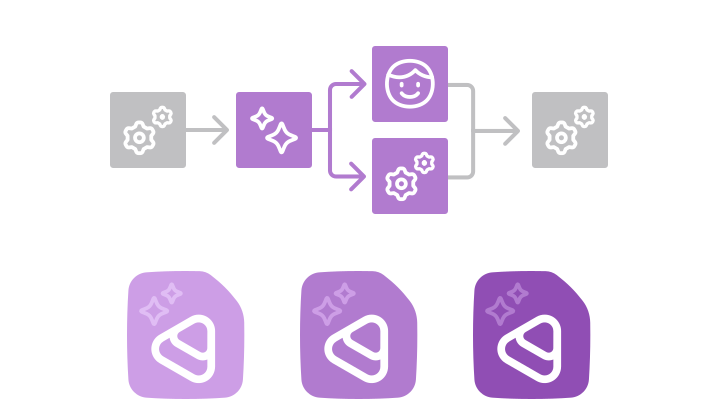
A blueprint is a proven, reusable process design for a complete business process. It combines AI, automation, and human decision-making in a practical and controlled way, and can be applied across multiple departments and industries.

We’re continuously expanding our AI blueprint library to cover more processes and use cases. Stay tuned!
Because each blueprint is predefined and already proven, implementation is fast and predictable across industries and teams. You know upfront what will be built, how long it will take, and what it will cost.
Each blueprint is also measurable by design, making impact tangible and easy to evaluate.
Instead of trial-and-error with AI tools, with our blueprints you will improve a concrete business process with clear expectations, controlled risk, and measurable results.