


Thank you! Your submission has been received!
Oops! Something went wrong while submitting the form.
By signing up for your free account, you agree to receive e-mails from Triggre.
By signing up for your free account, you agree to receive e-mails from Triggre.

Many organisations still build customer quotes by manually reworking supplier PDFs and spreadsheets. Operations teams copy data, apply mark-ups in Excel, and reformat everything into a customer-ready document. The result: delays, errors, and lost deals.
Here is a practical, step-by-step guide to optimise your quotation process using AI and workflow automation, based on blueprint thinking: combining AI and human intelligence in structured business processes.
Start with facts, measure:
In most cases, the biggest delay is manual data extraction and reformatting. That is your primary automation opportunity.
Supplier documents vary, while your quotes should not. Create a fixed, structured output format, e.g.:
This will serve as a template for your quotes. AI extracts data; your system maps it into this predefined structure.
In most organisations, transforming supplier data into quotes involves repeatable logic:
Document these rules explicitly. Many teams rely on tacit knowledge held by experienced staff. Making this logic visible is essential for scalable AI implementation.
Use AI-powered document processing to:
This removes manual copy-paste work and creates structured data ready for transformation.
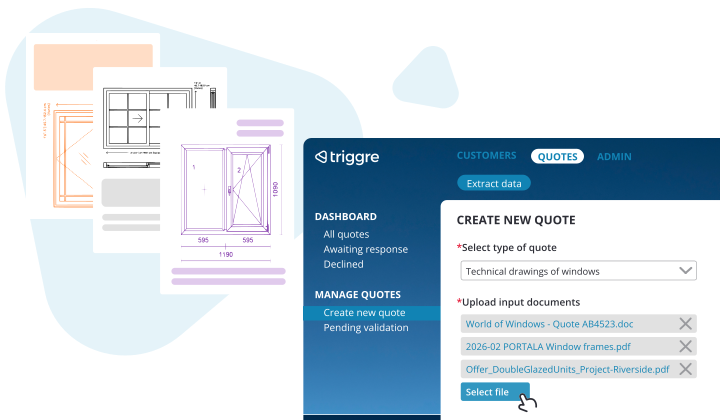
Once data is structured, your workflow automation platform should:
Only exceptions require human review. Standard quotes move straight through.

To achieve even more measurable business impact, integrate the process with CRM systems for opportunity tracking, ERP for pricing and product data, and approval workflows.
This ensures traceability, avoids duplicate entry, and enables reporting on KPIs such as quotation time and win rate.
After implementation, compare results to your baseline:
Many organisations significantly reduce quotation time, some even by 93%, when manual document rework is eliminated.
By applying AI within a structured blueprint, AI interprets supplier documents, automation executes business rules, while humans handle only exceptions. This approach delivers predictable results, limited implementation risk, and measurable ROI.
If your team is still rebuilding quotes by hand, this is an immediate optimisation opportunity: redesign the process, automate document handling, and turn supplier data into customer-ready quotes automatically.


