


Thank you! Your submission has been received!
Oops! Something went wrong while submitting the form.
By signing up for your free account, you agree to receive e-mails from Triggre.
By signing up for your free account, you agree to receive e-mails from Triggre.

This story keeps coming up, and it goes the same way every time.
A business builds an application with AI. It works. It goes into daily use almost immediately. A few weeks later it is running a real process, holding real customer data, and nobody ever made a decision to put it there.
The application was never bad. It was never finished.
The most useful thing an organisation can do at this point is change how it labels what it built. A vibe-coded application is a prototype. It is an MVP. It proved something, and that is exactly what it was for. What it did not do is become a product.
Vibe coding answers the most expensive question in software early and cheaply: should this exist at all?
Finding that out used to take a specification, a budget, and months of work. Now it can take a weekend.
A working prototype also does something a requirements document cannot. It gets used. People click through it, ignore the parts they do not need, and immediately ask for the parts nobody thought of.
That is the real output of vibe coding — not the software, but the knowledge.
Software that works in a demonstration and software that works in production are not the same category of thing.
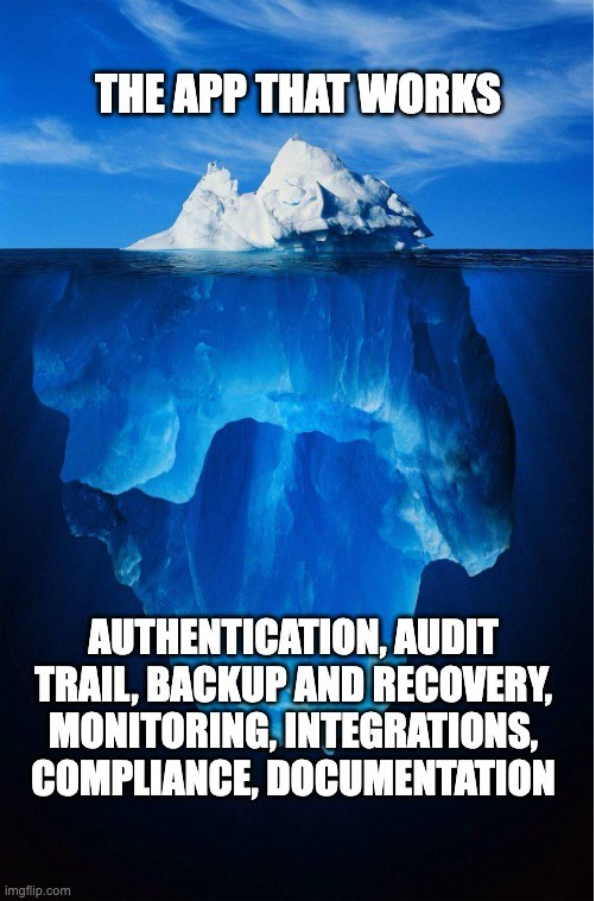
A demonstration involves one user, clean data, and the path everyone expected. Production involves several people editing the same record at once, an integration that changes without warning, a process that fails halfway through, and an employee who left the company but whose account still has access.
Handling all of that is a separate body of work, and most of it is invisible until it is missing.
None of this means the prototype was a mistake. It means the prototype was a prototype.
Consider an operations manager who builds an internal quote approval tool with AI over a weekend. It handles the standard case well, and the team starts using it. After three months, three things are obvious that were invisible at the start. A large share of quotes need a second approver the original design never anticipated. Sales representatives route around the tool entirely when a deal is urgent. Someone in finance re-keys every approved quote into the ERP by hand.
None of that was in the original idea. All of it is now known.
That knowledge is the return on the prototype, and it is worth more than the code. The organisation now has a specification written by reality instead of by assumption. Rebuilding on top of it is not throwing away the investment. It is collecting on it.
Vibe coding has changed how quickly an organisation can find out whether an idea is worth pursuing. That is a real gain and it should be used.
The failure is not in building the prototype. It is in never holding the conversation about what happens next, and letting a weekend project quietly become business-critical infrastructure by default.
Call it an MVP, take the lesson it produced, then decide deliberately what to build on top of it.

%20.png)

